
 If you are a student of the future events predicted in the Bible, you’ve almost certainly heard the verse quoted, “No man knows the day and the hour” (Matthew 24:36). My experience is that this is often brought up by folks who want to negate the revealed plan of the future that Bible prophecy presents. And I suppose a light reading of that verse could persuade some people to look at things that way. In other words, “No man knows the day and hour” so therefore “Forget about the whole thing! Don’t even try to understand it.” Or so they say.
 But I don’t think that’s the meaning or the intent the Lord had. For one, I certainly agree with the verse that, at that time and probably for now, no man knows the day and the hour of the Lord’s return. For one, back then, they didn’t need to know that because that wasn’t the main thing that was happening right then. Jesus Himself was the one Who said that no man knew the day and hour of His Return. He said this near the end of His ministry on earth, before His crucifixion. His return was still far off in the future. Also, if we just take literally what Jesus said, He said that no man knows the day and the hour of his coming. But that doesn’t mean that at some point in the future we won’t know perhaps the year, the month or even the week of His coming.
 Why do I say that? If you’re a student of prophecy, one of the most often-prophesied events in the Bible is the coming 3½ years of “Great Tribulation” that Jesus Himself spoke of. (Matthew 24:21). This three and a half year period is also mentioned in Daniel chapters 7 and 9 and extensively throughout Revelation. Over and over again we’re told about this period of “42 months”, “1260 days” and “time, times and half a time”.
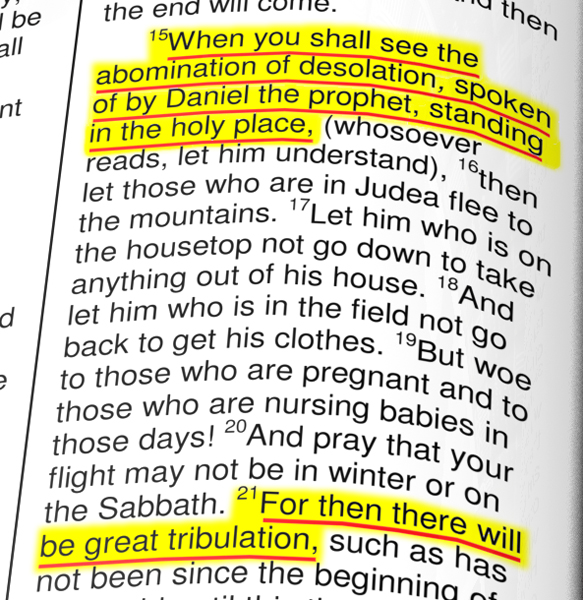 The Lord doesn’t waste His Words. This wasn’t put there for effect. While I believe that we won’t know the specific hour of the Lord’s coming, it is one of the clearest subjects of Bible prophecy that this period of 3½ years will come. Even the specific sign of the beginning of this 42 months is pointed out by Jesus Himself. In Matthew 24:15 and 21, He said, “When you see the abomination of desolation, spoken of by Daniel the prophet, standing in the Holy Place….then will be great tribulation, such as was not since the beginning of the world to this time…”. I’ve made a video specifically on this subject of the Great Tribulation that Jesus spoke of and which is revealed in Daniel. The video can be seen here.
At the time of Jesus, no man knew the day and the hour. But the people of the future will be able to have a pretty good idea of how much time there is left, those ones who will pass through the last years and months before the Lord’s return.
Why? Why would the Lord want anyone to know when He was coming back? I believe there are several reasons. For one, it’s going to be a time of tremendous hardship for believers and worshipers of the God of Abraham. But for those who know these verses in the Bible, it will be an anchor of their faith that it’s only for an appointed time, that it will have an end and that end will be the Lord’s coming.
 Also it will be something that can be used as a witness to the waverers and the undecided. When the believers in God can tell the undecided what is going on, that it’s the time of the Antichrist and that all those things have been predicted for centuries, it will be a witness and testimony to millions. That’s why it says in Daniel 11:33 “And they that understand among the people shall instruct many”. This comes only two verses after the verse that Jesus Himself pointed to in Daniel when He was teaching about the time before His coming, Daniel 11:31.
 Yes, “No man knows the day and the hour”. No one knew it at the time Jesus said that and no one knows it right now. But I believe that there will be those of us in the last 3½ years before His return or even in the last 7 years before His return, who will have a pretty good idea of the year, the month and perhaps even the week of the Lord’s return. And it will be a tremendous help and blessing to know that as the believers at that time will face troubles unparalleled in history.
So if someone tells you “No man knows the day and the hour”, don’t let that rattle your faith. Know what the Word says and what is repeated again and again in Daniel and Revelation about the specifics of the Last Days. Then you’ll be strong, prepared and you can “instruct many”. (Daniel 11:33)





 To build a house, you’d start out with the foundation, then the framework, the walls and last would be the finishing touches. Jesus Himself pointed His disciples to the Book of Daniel and told them, “
 To paraphrase Paul, I believe God is the “
 It all fits wonderfully together, both the information God gave in the Old Testament, primarily through the prophet Daniel, then what Jesus taught about the matter in Matthew 24 and the places Paul talked about the subject, like in II Thessalonians. There are other places as well but I’m just hitting the highlights here. All these things are the building that was done by God through the Scriptures, “
 But Jesus talked a pretty good amount about freedom. In fact, He promised it. “
 I began to have a freedom, a peace, a joy and even words that there may be no words for, maybe close to the word “ecstasy”. But I don’t find the word that fits, really. Simply put, it was a form of freedom and deliverance from the fear, confusion, bondage, lack of direction, just the overwhelming lack in every area that was the essence of my life before my coming to God.
 Most churches are so “afraid of wild fire”, that they have little or no fire of the Spirit at all. Besides, only a few are beginning to tell the sheep in their congregations that actually they are responsible to not just “
 We’re free, free, free; free to do God’s will. Free to “
 How many people are daily living in that glorious liberty to the full in the action-packed, thrilling, significant destinies His saved children can have right now in this world, if we seek first His kingdom. Oh, that the Lord would be able to help more of His people to drink more deeply of His freedom and the things of Him now in this lifetime. “
 Peter vehemently refused saying, “
 Even though he was a man of God, Jonah must have had some major things in his heart, “lying vanities”, which kept him away from the mercy of God. Until it seemed utterly too late. But it wasn’t. There in the whale’s belly Jonah said, “
 Jonah then went to Nineveh and declared God’s message, “
 things of the Spirit can be processed in such a way that there’s still some substance left there but essential ingredients have been removed. It’s actually expressed rather well by Paul the Apostle when he said that one of the conditions in the future would be that people would have “
 any who would process and purify what they feel needs to be removed from God’s truth. It reminds me of how the original Christianity was founded in the early church. Paul said he had “
 It’s a rather convicting thing to try to answer or respond to what this dear one wrote. It is true that judgmentalism and a “
 Some might even ask, “What is a pilot light?” Well, on gas stoves, maybe only on older ones now, there was beneath the surface of the stove a small flame, a pilot light, that stayed on constantly. Then, when someone turned the knob to get the stove to come on, the pilot light was there to light the flow of gas so that it provided flame on the burner on the stove.
 It says in the Word about this, “
 When Dwight L. Moody was an insignificant shoe clerk over 100 years ago, someone witnessed to him and led him to the Lord. And Dwight L. Moody went on to become one of most successful evangelists in American history. Or there’s the preacher who was speaking to a small gathering of ladies in a Scottish church on a gloomy, rain-drenched day about the need for missionaries to Africa. Unbeknownst to him, up in the balcony was a young man who was adamantly taking in every word of the preacher. That young man was David Livingstone, one of the greatest missionaries who ever went to Africa.
 “
“ Maybe a thing to do with some of this is what I’ve heard before, to “wrap it up in a bundle of faith and put it away somewhere”. When the time comes, the Lord will take it, unwrap it and make it all clear and plain.
 “
“ I do strongly believe that more people need to have a much better understanding of the events that we’re told about in Daniel and Revelation which have not yet happened. But I think any teacher who seriously makes an attempt to teach the book of Revelation to others must have the honesty, humility and candor to say at some points, “I don’t really know what this means here or at least I don’t understand it enough to be certain about it.”