
 Does God ever send His wrath on His own people? Usually, I’d be the first to affirm that He does not. A well-known Bible verse tells us, “God has not appointed us to wrath but to obtain salvation through our Lord Jesus Christ” (1 Thessalonians 5:9). Trials, tribulations, even sufferings—those are things that a child of God can and does experience. But wrath is evidently not something He sends against His people.
Or does He?
I was looking over verses I’ve memorized throughout my life today, and I came to this one: “But they mocked the messengers of God, and despised His words, and misused His prophets, until the wrath of the Lord arose against His people, till there was no remedy.” That’s from the last chapter of 2 Chronicles, describing the final state of the inhabitants of Jerusalem and Judah as the fearsome forces of Babylon came against them for the third time, around 586 BC.
Then I thought about a prophetic verse that evidently refers to a time soon to come, from Revelation 18: “And I heard another voice from heaven, saying, ‘Come out of her, My people, that you be not partakers of her sins, and that you receive not of her plagues‘” (Revelation 18:4). This has to be the voice of the Lord, clearly speaking to “My people,” the saved believers of the last days, imploring them to “come out of her.” And the “her” referred to here is Babylon the Great, the mysterious end-time entity, “that great city which rules over the kings of the earth” (Revelation 17:18).
There’s a case to be made that these verses in Revelation can be applied even now, to the people of God in this present age. Some say that Babylon the Great is now fully formed and manifest in our time, and that the people of God must “come out of her”, if they are not to receive her plagues, both now and in the times soon to come.
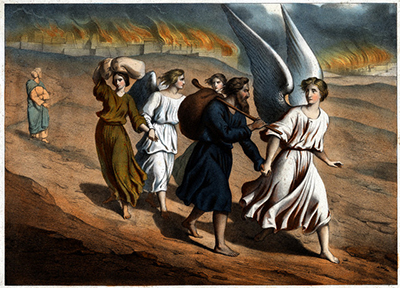
A strong comparison could be drawn to Lot, the nephew of the patriarch Abraham, some 4,000 years ago. Lot and his family were increasingly “vexed with the filthy lifestyle of the wicked” (2 Peter 2:8) as they continued living in Sodom and Gomorrah. In Lot’s case, the Lord finally sent angels physically to escort Lot and his family out of Sodom, evidently in the final hours before God poured fire and brimstone upon what had become Lot’s hometown.
But what about now? God says in Revelation that the day will come when the sins of Babylon the Great will have reached unto heaven, and He implores His people to come out. But what if they don’t? What if they are like the impudent, stiff-necked people who inhabited Jerusalem and Judah in the days of Jeremiah? That man was God’s voice to his nation for forty years. And, as we read in that verse from 2 Chronicles, they mocked the messengers of God, despised His words, and misused His prophets until the wrath of the Lord arose against His people. In this case, when God’s own people have so hardened their hearts and shut their ears, He sometimes allows them to suffer the consequences of their grievous sins.
The good news is that there were a few, even in Jeremiah’s time, who took heed to the warnings of God and the voice of His Spirit. Daniel and his friends were carried away to Babylon as young men, and Daniel went on to become one of Israel’s greatest prophets. In fact, Jeremiah, Ezekiel, and Daniel all lived during that period, with Jeremiah being the oldest by about a generation.
But we don’t know much about the vastly larger number of people who were the mockers and scoffers, the hardened people who were called by His name but perished in the flood of judgments that the Lord had been warning them about for decades. And the thought has come to my mind: Will there be multitudes of believers in the coming judgments of God upon this earth, described in Revelation, who will be in such a state of lukewarmness, complacency and indifference that they simply will not obey when the Lord says, “Come out of her, My people”?
 What is going to happen to disobedient Christians, those who are so joined to modern Babylon that they will be much like Lot’s wife, who had to be virtually dragged out of Sodom, the Babylon of her day? If the modern lukewarm do not “come out of her” (Babylon), do those verses imply that they will then “receive of her plagues”?
I believe that “God has not appointed us to wrath.” That is clear from Scripture. But what about half-hearted Christians who have spent their whole lives, in one form or another, within the allurements of Babylon the Great? These thoughts came to me this morning, and they are unsettling.
There is certainly Scriptural precedent for God allowing severe punishment to come upon those of His people who have hardened their hearts and mocked the messengers of God. May the Lord help us all.

 Bonded labor in that form no longer exists here in the United States, as far as I know. But severe poverty, often driven by heartless mercantilism, has been a reality for people throughout history. John Steinbeck’s The Grapes of Wrath, written in 1939, was a blistering critique of the conditions farm workers faced in California at the time—working for 25 cents a day, barely staying ahead of starvation.
 So, what can I do? What do I plan to do? First, I can write this and share it with you, my friends. I can ask for your prayers—not only for me, but especially for this exploited man and his young family. You don’t need to know his name or his country to lift him in prayer.
 But I can still help this man and his family. I’m sure not rich but I do have enough to try at least to buy this man out of utter literal slavery and into some form of labor that will lift them up to a more endurable daily existence.
 Britain is a vivid example. In some places, local councils have gone so far as to order police to stop people from flying the Union Jack, Britain’s flag, on their own property! Meanwhile, others are arrested merely for standing silently across the street from abortion clinics. Such measures show just how far things have gone astray.
 They strongly call us to something higher than the present putrid stench of politics that too often drags us down to the worst in humanity, no matter our race, nationality, or status.
 nstead, He continues to guide and prod us along towards worthy actions that we can take to be like the woman Jesus referred to, “

 “So, Mark, are you religious? Do you think that religion will solve the problems of the world today?”
 I can see how that question asked by someone else, seeking to understand me better and what I stand for, might have said the same thing. In that case, it would be easy to hear the sincerity in their voice and in that situation I would have answered completely differently.
 Most of the people at this get together had already viewed
 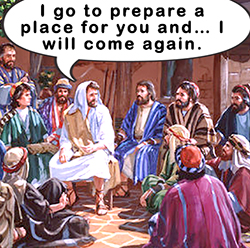 I felt led to pull together a list of blog articles that I’ve written over the last 10 years or so, touching on some of the most common questions that people have when it comes to the subject of what Jesus was referring to when He told His disciples, “
 I’ll include here some of the articles that I shared with these ones, primarily related to questions people have about the return of the Lord. Often you can hear folks say, “Oh,
  A similar thing people say on this subject, and they quote Jesus, is this: “
 And you may have heard someone surprisingly tell you something like, “Oh, Jesus actually returned to the earth in 70 AD!” How can you factually and tactfully reply to someone who is saying that? I shared this article with my friends on this subject and how they might respond.
  A question for many was, “How close are we?” “Can we tell in specifics how much longer it will be?” Big subject, big questions. Here’s what I shared about this, perhaps one of the articles that has been discussed the most,
 I shared with them an article about my own experiences here over the last year or so involving the local school district I’m in and the battle there for the hearts and minds of the young people who go the schools near me. Here’s an article I shared with my friends about that.
  PS You might be interested to know what the atmosphere and mood was at a get-together like this of dedicated East European Christians. Seven years ago I was living in Romania and went to a similar gathering. Here’s an article I wrote about how that was.
 But for a couple of years, I’ve been deeply concerned about situations happening in my local community. I wrote about that in a recent article, “
 The Samaritan stopped on his way to help a man who’d been beaten by robbers. According to Jesus, several very religious priestly types had already passed by before but they’d done nothing for the beaten man. In other words, taking personal, physical action to alleviate the wrongs we are confronted with in this world is definitely what Jesus did Himself and what He taught in the gospels as well.
 Maybe it’s like what Jesus said, “
 Again, there’s so much overstatement in our times that if I try to tell you what’s going on, you’ll very easily default to the “my eyes glaze over” attitude that so many of us have had to take on, just to survive all that we’re almost assaulted with.
 They explain that they’ve been learning in public school that they’re free to choose their gender and that they can be liberated from the shackles of society’s bonds and “to be what they inwardly have come to realize they really are.”
 And there are school board elections coming up in the elections in November. While we are so swapped with controversies about national elections, the fact is that the members of your local school board are the ones who make the decisions as to what is let into the curriculum of the schools your kids and grandkids go to. And what is kept out.
 “
“