
 Have you ever said that to someone, “What’s it to you?” Or maybe someone’s said that to you? It’s usually not considered a real warm, friendly way to talk to someone. But Jesus said that one time to Peter, one of His top disciples. Why would Jesus talk like that to someone? Let’s look at the context and see if we can find out.
This all happened after Jesus’ resurrection. In another blog article, I wrote about “He Said It Three Times” and this is part of the same conversation where Jesus said “What’s it to you?” (John 21:22) to Peter. He’d just told Peter three times to “Feed My sheep” (John 21:16), to teach and minister to the disciples and followers of Jesus.
And the very next thing the Lord said to Peter was, “When you were young, you fastened your belt and went where you wanted. But when you grow old, you’ll stretch forth your hands and another will carry you where you do not wish.” (John 21:18) And the Bible goes on to tell us that the Lord was signifying to Peter that, when he was old, he would “stretch forth his hands”; in other words, Peter would be crucified.
So this was a very important, significant conversation Jesus was having with Peter, all taking place after the Lord’s death on the cross and His resurrection. What was Peter’s reaction? The Bible says that the next thing was that Peter saw John, another of Jesus’ closest disciples, and so he asked Jesus, “What about him?” (John 21:21)
Sometimes you just wonder and marvel at all this. The love and patience of Jesus. The all-too-humanness of some of His disciples, perhaps especially Peter. Peter had just heard some precious, personal words from Jesus for himself. But it doesn’t come across that Peter really relished the moment and its significance. Instead he asked the Lord, “What about John?” In His mercy and longsuffering, the Lord even partially answered Peter’s question but then also added a chiding reproof.
 Jesus answered Peter’s question about John this way: “If I will that he remains until I come back, what is that to you? Follow me.” (John 21:22) In that one sentence, Jesus left open the possibility that John the Beloved would remain alive till the return of Jesus at His Second Coming. History tells us that John lived perhaps another 60 years after this time, to extreme old age. And here Jesus was foretelling that John would remain long after the Lord had returned to heaven.
But then Jesus asks Peter directly, “What’s it to you?” “Why should that matter to you, Peter? Just follow Me.” Of course it should be said that there are different ways you can say that. You can say that phrase in a cocky, challenging way or you can say it in a kind but somewhat chiding way. I’m sure the Lord spoke that in a kind way. But why would the Lord talk to Peter like that, even if it was kindly said? Was Jesus finally getting fed up with all the boneheaded things Peter had done and said over the last 3 years? Patience was wearing thin? I think not.
 Here are a couple of things that Jesus might have foreseen that He was trying to prevent happening to His disciples as He was about to leave them: comparing and jealousy. Even before His crucifixion, His disciples were coming to Him to ask Him which would be the greatest of them in heaven. (Matthew 18:1)
There’s just an inborn sinful nature of man to “compare ourselves among ourselves and measure ourselves by ourselves” (II Corinthians 10:12), as Paul later warned the Corinthians. Getting our eyes on each other, “which is the greatest?”, “who gets most?”, “do I get enough?”, “will someone get more than me?”, and “is that really fair?” It’s just so ingrained in us but is so contrary to God’s ways.
Basically Jesus was telling Peter to not look too much on how others were doing or what was happening or going to happen in their lives. “Just follow Me”, was Jesus’ bottom line to Peter. And perhaps this reproof hit home for Peter. It seems like Peter and John got along well and were never recorded in the later parts of the Bible as ever having any strife or competitiveness, although I’m certain that Satan would have loved to stir that up.
But what about us? There’s a message there for everyone, not to feel we have to measure everything against our own personal standards of what’s fair and “am I getting what I deserve?” Maybe you’re even in an “unfair” situation right now. Maybe people are treating you unjustly or you’re being taken advantage of. “What is that to you; follow Me.” The Lord said one time, “Vengeance is Mine saith the Lord, I will repay.” (Romans 12:19)
It doesn’t have to be fair right now. The Lord sees it all and we can be utterly sure, “all things work together for good to them that love the Lord.” (Romans 8:28)
 To me one of the greatest samples of this in the Bible is Joseph. If ever anyone was mistreated and “it wasn’t fair”, it was Joseph. His brothers actually sold him as a slave! But years later, when he’d been shuffled and reshuffled by God to end up being “second in Egypt” (Genesis 41:43), he met up with his brothers again and they were certain Joseph would now pay them back for the evil they’d done.
But he didn’t. His heart was so right with God that he could say to them about what they’d done, “You meant it for evil. But God meant it for good.” (Genesis 50:20) One of the most amazing examples in the Bible of keeping your eyes on the Lord and not on people and circumstances and conditions. Seems like Joseph had already learned that lesson that Jesus shared with Peter nearly 2000 years later, “What is that to you? Follow me.” Joseph did that. And he ended up saving his family and nation. Lord help us all to keep our eyes on Him and not on anything else.


 But there are times where the best choice is just to step back and walk away, as difficult as that may seem to be. It’s a little like what I wrote about in the post about the old story called “
 Or this one, one of my favorites, “


 I have some friends here with master’s degrees or doctor’s degrees and often I’ll hear from them that “



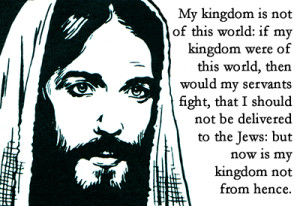 Pilate asked Jesus if He was a king. And Jesus said, “
 Another article, “
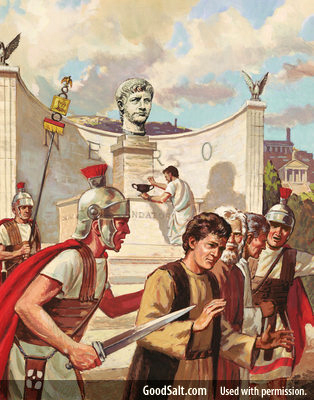 This dilemma, this tension, has historically led many believers to make stark, immediate decisions. Early Roman Christians were often forced to choose between pledging allegiance to the Roman emperor or facing death. Countless numbers chose to stand with Jesus Christ and the God of Abraham, rather than with an earthly king or country. It’s easy to think, “That could never happen here. We’re too advanced, too modern, too intelligent for that.”
 Our true calling is to stand for the truth of Scripture, especially using the power of prophecy to share the reality of the world’s condition and the possible impending fulfillment of end-time events. It is there that I believe the Lord is waiting for us, calling us to be His army of faithful witnesses, proclaiming what has been foretold for over 2,000 years—the final events before His return.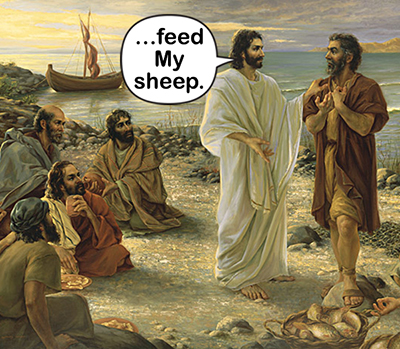
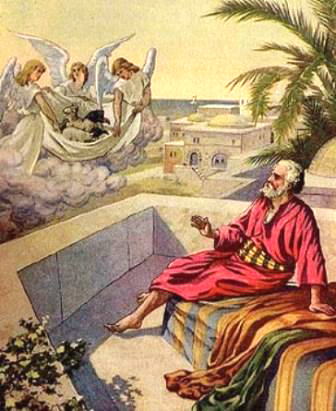 And strangely, another time in the Bible it says that Peter was told something three times from God, in no uncertain terms. In Acts chapter 10 Peter was in Joppa in northern Israel. Peter was the head of the growing group of believers who spread Jesus’ message and truth, after He’d ascended to heaven years before. Peter was on a house top, in prayer, when in a vision he saw a sheet let down from heaven with all kinds of “unclean” animals. The Laws of Moses gave strict rules for the Jews as to what animals were “clean” to eat, permissible, and which ones weren’t.
 The Jews weren’t supposed to have anything to do with Gentiles and certainly not go to their house.
  In Daniel chapter 8 something similar also happened. In a vision, Daniel was by the river Ulai, in what’s now modern Iran, and the angel Gabriel was commanded to explain what Daniel had just seen, a goat and a ram clashing in battle and the goat conquering the ram. But there was more to it, much more, and Daniel tells us he just didn’t understand it. But the angel Gabriel then tells Daniel three times in two verses that “
 “
“
 In John chapter 6, Jesus fed the multitude miraculously. We are told “5000 men” were there, so we can assume it was even a lot more people than that. After dividing up 5 loaves and 2 fishes to feed all those people, it says Jesus understood that there were those among the multitude right then who would “
 So, multitudes or disciples. And isn’t it the same today? Thank God that